







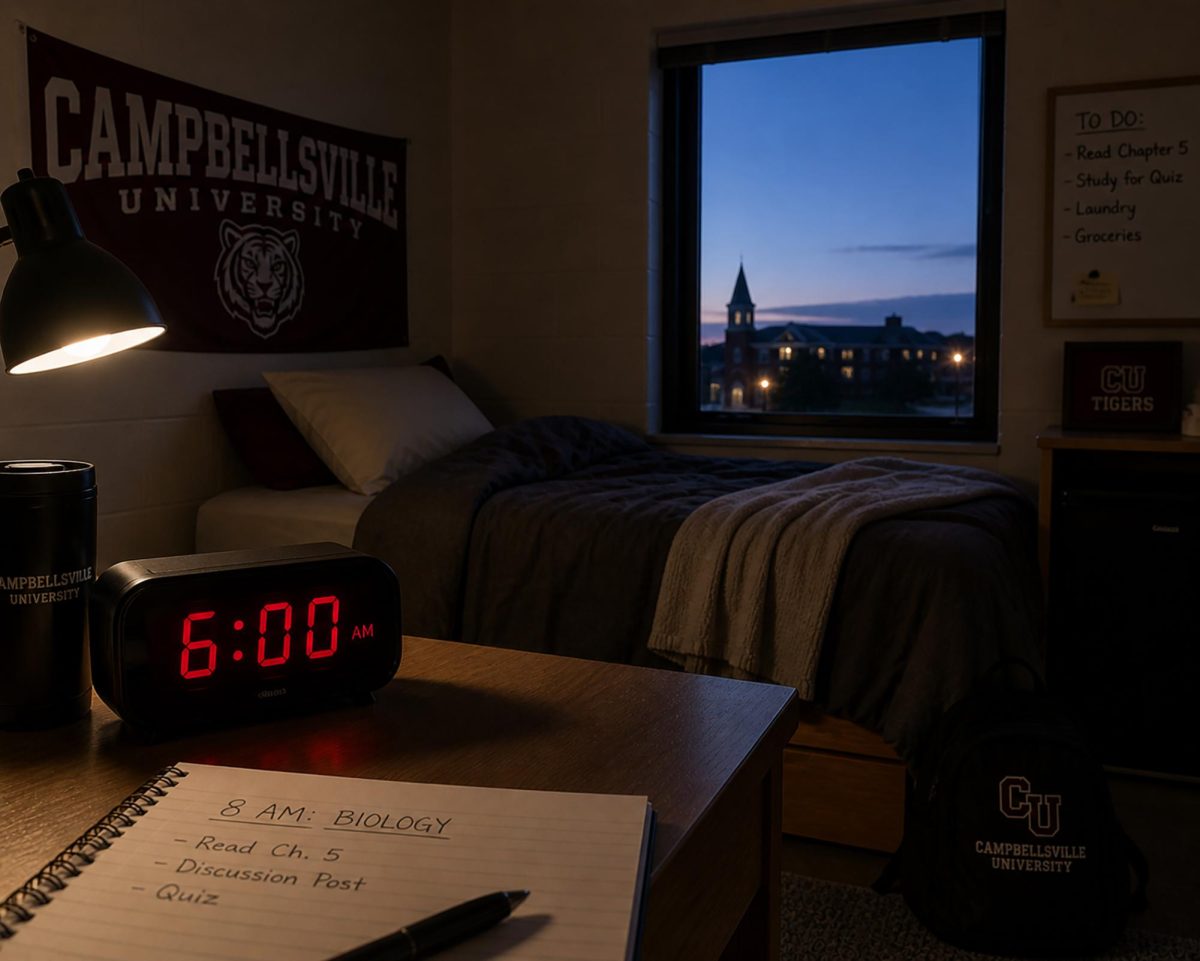












Campbellsville University Residence Life recently announced that electric scooters are no longer allowed in residence halls or any campus buildings and must now be stored outside.
ResLife announced this change earlier this semester after there were fire safety concerns with charging the batteries indoors. Residence Life Director Elijah Coffey, who declined an in-person interview with The Campus Times, wrote that the decision was made in coordination with the fire department to protect students and property.
“Scooters are not permitted to be inside any building on campus per the instruction of the local fire department,” Coffey said via email. “This is instruction from the local fire department for the inside of buildings and comes with legitimate reasoning for the safety of the CU Community.”
Violations of the new policy may result in disciplinary action.
“Due to the concerns by the local fire department, this could result in a charge of reckless behavior and insubordination,” Coffey wrote.
With the new policy, students are required to keep their electric scooters outside, and the change leaves very few options for safe storage and charging. Coffey did not respond to questions about the results of weather-related damage.
“Students are welcome to keep them on university-provided bike racks or in their personal vehicle,” Coffey wrote.
While residence halls have racks nearby, several academic and administrative buildings do not.
“Bike racks remain present in the areas around residence halls and in various strategic locations around campus,” Coffey wrote.
He added that installing additional racks for buildings without them would depend on student demand and encouraged students to bring requests to the Student Government Association.
“Ultimately, the goal is to keep the community safe,” Coffey wrote. “Campbellsville University does not wish to deprive students of a hobby they enjoy but must adhere to the instructions of local agencies and in line with the safety protocols of the institution.”
For students who rely on scooters to get to and from work or school, the new rule has created daily challenges. CU student Remy Angel Terceros Paredes has felt the impact firsthand.
“Well, normally I used to [ride] it every day because I work at 7 a.m.,” said Paredes. “Because I have to charge it outside, I just haven’t had the time to do so. And also, because the weather has been unpredictable lately, I wouldn’t want to charge my scooter outside, not knowing what will happen if it’s going to rain or something.”
Paredes said keeping his scooter outside has made it harder to rely on for work and classes. Like many students, he’s concerned about the lack of covered areas or outlets where he can safely charge it.
“I had a problem with my own scooter…because one night it rained a lot,” Paredes said. “I woke up the next day and the whole next day was raining. My scooter didn’t turn on. So, my only guess was that it just got ruined by the water.”
Paredes said he believes the university should consider creating a covered or designated area where students can safely store and charge their scooters. He said having a space to charge would make it easier for students who depend on scooters for transportation to follow the rules without worrying about weather or damage.
“I think there should be a place specifically for scooters where you can charge it without being concerned about raining or weather in general,” said Paredes. “If I leave it outside charging, there’s always a concern. What if somebody takes my charger or what if while I’m charging my scooter, it starts to rain.”
Enforcement of the new rule, however, hasn’t been consistent across campus. CU Resident Assistant Jayden Gonsalves said it’s applied more strictly in residence halls than in the village dorms.
“For the villages, it’s not as necessary as like the South Hall or any other hall so I am fortunate to keep mine inside, but I do not like to charge mine at night just as a safety precaution,“ said Gonsalves. “In South Hall we do slightly enforce it, but it’s also 50-50 because we understand that there are no outlets outside and some of the outlets might be damaged. So, if they have to charge it inside, as long as they bring it back outside afterwards, then we’re okay.”
He said the rule has frustrated some students who rely on scooters for transportation.
“It’s kind of a 50–50 situation,” said Gonsalves. “We’re on campus grounds, so it’s campus property, but at the same time they’re telling students to put their personal property outside.”
Gonzalves also said creating designated storage or charging stations, even outdoors, would help address safety concerns while supporting students who depend on scooters.
“Even if it’s outside, at least if it has a canopy or charging stations, that would be very beneficial for not just the campus but for students as well,” he said.
He added while safety precautions are necessary, banning scooters outright wouldn’t be right.
“I don’t believe there should be a ban,” Gonsalves said. “In the villages, classes are a little bit farther away. Not everyone has a license so they would have to walk a very long distance.”
For now, the policy remains in place as CU continues to prioritize safety. Some students understand the reasoning but hope CU will consider adding covered areas or charging stations in the future to make it easier to comply with the ban. Despite the challenges, students say they’ll continue adapting to the new guidelines while waiting to see if the
university makes changes in the semesters ahead.