















Artificial Intelligence is transforming the job market every day, especially for graphic designers. Graphic design is the professional practice of creating visual content, such as logos, social media posts, branding and more. Increasingly, however, people are turning to AI to create generic brands in 10 seconds rather than unique logos in 10 days.
“Yes, AI will replace designers, writers, illustrators, filmmakers and all the functional roles we consider professional in the creative services realm,” Ted Leonhardt, an adviser to creative firms, wrote on the Medium website. “It could happen quickly.”
Graphic design students at Campbellsville University have been made aware of AI almost every day, in almost every class. They talk about the potential future with AI frequently, as it has already started to affect some of their plans.
While the exact number of graphic design jobs being lost is not known, related jobs like illustrators and writers have experienced a 25% loss of positions making graphic design roles a “top at-risk” job, according to the 2025 World Economic Forum report. The report surveyed more than 14 million workers across 55 countries and identified graphic design as the 11th fastest declining job in the next five years. That’s nearly 50 million U.S. jobs that are being affected just from OpenAI alone, according to Creative Boom magazine.
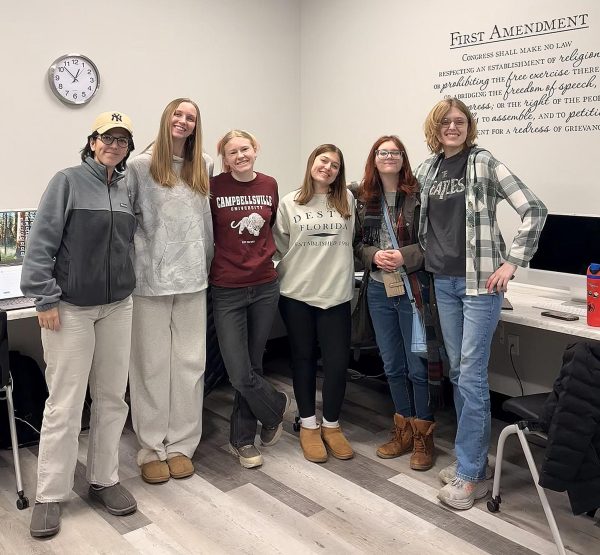
CU sophomore Chloe Leachman is a graphic design student, and she’s expressed concern for her future.
“I think it has scared me a little in wondering if my career will work out,” she said, “mainly because people seem to love convenience over real human art.”
Leachman, who is also a photographer, uses AI to help her edit clients’ pictures. She said it saves her time.
“I use AI for generative AI removal in photography, but that’s about it,” she said. “I think it’s nice for editing out objects in photos for photography, so that it is convenient and fast rather than photoshopping slowly.
CU junior and graphics student Riley Thorne has gone as far to say she’s working on a backup plan.
“It has made me second think my future with this degree regarding how many people might be reaching out to AI first for logos or such instead of graphic designers,” she said. “I am personally going to take a master’s in business as a bail out because I am honestly quite nervous about AI taking over graphic design.”
Like Leachman, Thorne uses AI as a tool.
“I have been starting to use AI as inspiration for my designs only,” she said. “It is a great tool for trying to figure out different pathways for projects, but also apps like Pinterest do the same thing.”
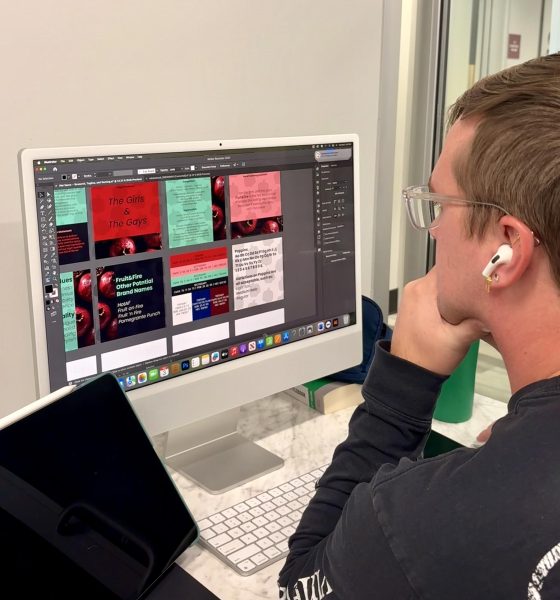
Kaleb Trent, a CU junior and current freelance graphic designer, said that AI threatens creativity because of the lack of using our own tool – our brain.
“I think the brain is a tool and if we stop using it, it gets weaker,” he said. “Using AI to replace creative thinking is a major issue… We [the music department] are starting to see lots of color guards and marching bands use AI to make show announcements and you can definitely tell when someone does. Pianos with incorrect keys, third arms, too many fingers.”
Trent worries that soon, clients will be choosing AI over human art.
“Look at show graphics right now. Look at the weather graphics being posted right now,” he said. “All you have to do is scroll 15 seconds on Facebook and you’ll see something AI.”
However, it’s not all bad news. Corey Cundiff, assistant professor of art and design and the graphic design instructor at CU, takes a more balanced approach to AI in the classroom.
“No, I don’t think AI will replace creatives,” he said. “I think it will continue on its path of creating soulless reproductions of others’ work and that will be its pinnacle of its ‘creative limitations. It is us, as artists, that breathe life into our work. AI generally mixes up and regurgitates what it sees.”
Cundiff encourages his students to use AI strategically rather than avoiding it entirely.
“It’s a complicated line to walk because we stress originality as artists,” he said. “However, we don’t want students ignorant to the capabilities of AI. So, I encourage students to use AI but only in the sense that they use it to better themselves. AI programs are excellent at critiquing your work or giving feedback on an idea that you have, but I wouldn’t encourage them to use it strictly for image generation, especially considering the harsh realities of copyright law.”
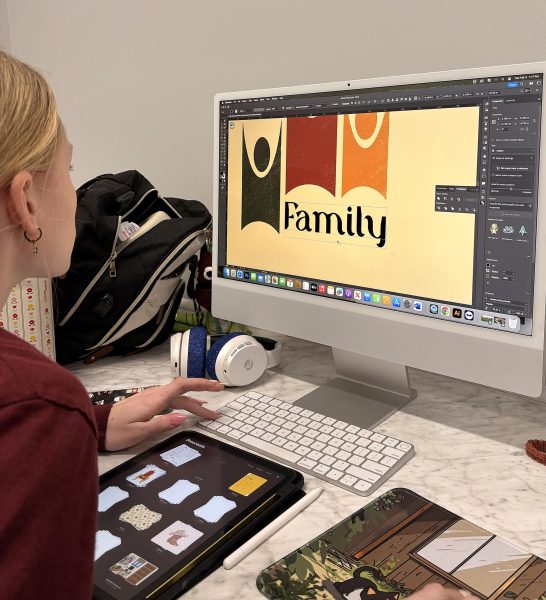
The World Economic Forum does show that traditional roles are at risk to decline. But advanced roles like UI and UX design are ranked the 8th fastest growing job category. UI or User Interface does consist of graphic design elements like branding, color pallets and visual aesthetics, while focusing on how an application (app) works. A good example of this is Spotify’s vibrant images, Duolingo’s streak counters and Dark Mode used across multiple apps. UX or User Experience focuses on the functionality and user journey. This includes Netflix ‘s “skip intro” button, and “Spotify Wrapped” that comes out every year.
Despite the concerns from students, Cundiff remains optimistic about the future of graphic design.
“Don’t fret, history has seen many advancements of this magnitude and the world is still turning,” he said. “We only fear what we don’t understand. I think educating ourselves on AI is the best thing we can do to get over that fear. Maybe new career paths will branch out of this, or maybe graphic design will intertwine with AI somehow. We just need to be patient and see.”
Editor’s note: Reporter Marissa Toms is a junior at CU majoring in graphic design and minoring in digital media.