












Graduation rates are often one of the first statistics students and families see when researching colleges. At Campbellsville University, those figures raise questions when viewed without context.
CU calculates its undergraduate graduation rate using national standards set by the National Center for Education Statistics through the Integrated Postsecondary Education Data System, commonly known as IPEDS. These standards are used nationwide to allow comparisons between institutions.
“We typically officially use the National Center for Educational Statistics data as our official graduation rate for undergraduates,” said Donna Elkins, associate vice president for institutional effectiveness.
Under NCES guidelines, graduation rates track whether first-time, full-time students complete a bachelor’s degree within six years, which is the federal standard. Students who begin college part-time or who previously attended another institution are not included.

According to NCES data, only 14% of CU’s entering students in 2023 met this definition.
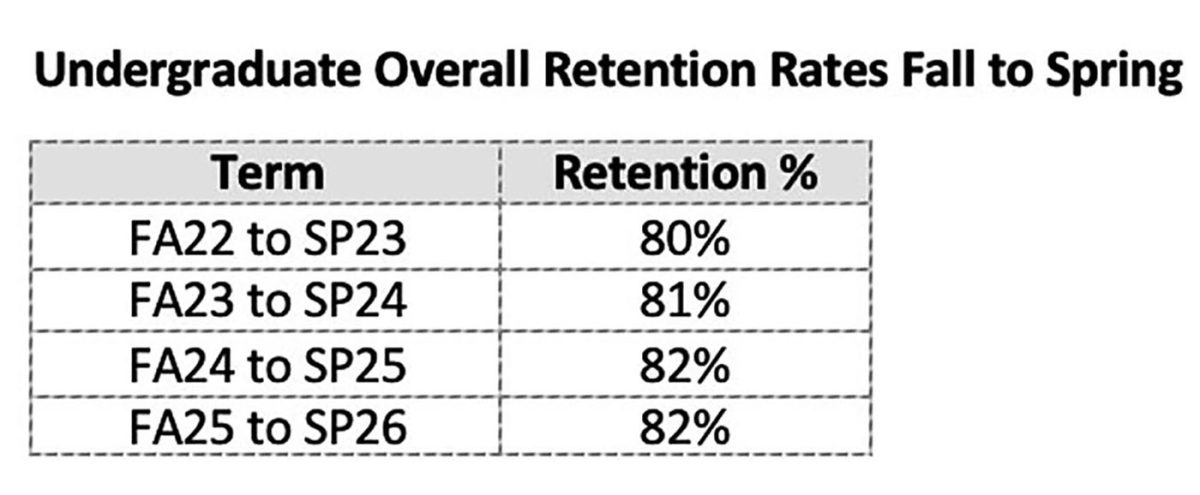
Retention rates measure whether students return the following fall. Among first-time students pursuing bachelor’s degrees at CU, 64% of full-time students returned the next fall, compared to 22% of part-time students.
“One big caveat is, this does not include students who have transferred,” Elkins said. “If we were to add those students into the graduation rate, it would obviously go up a little bit, but we do not add those students.”
According to NCES data, 42% of students who began at CU in fall 2017 completed a degree or other credential within six years.
For students pursuing bachelor’s degrees, the four-year graduation rate for the fall 2017 cohort was 30%, with a six-year graduation rate of 42%.
“Our four-year graduation rate has pretty much been steady around 30%,” Elkins said, adding that comparable institutions report similar outcomes.
The fall 2016 cohort recorded an unusually low four-year graduation rate of 8%. Elkins specifically referred to this drop as an “anomaly,” attributing it was largely due to disruptions caused by the COVID-19 pandemic in spring 2020.

“A lot of students either withdrew or stepped out for that semester and came back in the summer or fall to finish,” Elkins said.
Despite speculation, academic performance does not appear to be the primary reason students leave. In the fall of 2024, 88% of first-time, full-time freshmen earned a GPA of 2.0 or higher, increasing to 90% in spring of 2025.
“Whether or not you graduate is often a very individual situation,” Elkins said.
Although CU does not currently have a formal graduation rate benchmark, the university aims to continue monitoring graduation data over time and see improvements as time passes.
“I would like to see us at the four-year rate be 35% to 40%,” Elkins said. “And then at the six-year rate to be maybe 45%.”
While graduation and retention rates provide important benchmarks, Sarah Begley, director of academic advising and retention, said those numbers don’t fully capture how student success is defined on campus.
“I think all of us would say it’s about the relationships we have with our students, and it’s about seeing them meet and exceed their personal goals,” Begley said. “Yes, numbers matter, but student experience is at the heart of what we do here in the BASC (Badgett Academic Support Center).”
Begley said student success looks different for every individual and often extends beyond academic performance.

“Seeing a need and meeting a need – and that might look different for each student,” she said. “To me, student success is about seeing each student and knowing they’re healthy and happy here on campus.”
According to Begley, the first year of college plays a critical role in whether students persist.
“It’s the foundation,” Begley said. “That first year is all about getting them connected, getting them engaged, giving them a reason to call this place home.”
She said connection and engagement early in a student’s experience, sometimes within the first week, are key factors in retention.
“I think that connection and engagement is crucial within the first week, let alone the first few months of the first-year experience,” Begley said.
Begley noted that students who step away from the university often do so for non-academic reasons. Financial pressures, work-life balance and the lingering effects of the COVID-19 pandemic have shaped student decision-making nationwide.
“We survived a pandemic. Unprecedented,” Begley said. “Higher ed is seeing their numbers impacted across campus, so it’s not a unique challenge to Campbellsville.”
She also pointed to the university’s large first-generation student population as an important consideration.
“They don’t have someone in their homes that have gone through a traditional college experience,” Begley said.
To address these challenges, CU has expanded student support resources in recent years, including success coaching and early alert systems that allow faculty and staff to intervene before students disengage.
“The early alert has been crucial in helping students recognize that their faculty genuinely care,” Begley said. “They see them as an important part of our university family.”
Begley said graduation statistics should be viewed as one part of a much larger picture.
“A standalone number can’t possibly tell you the whole story,” Begley said. “It’s way beyond one metric.”