

















Not every international student who comes to the United States in search of opportunity finds an easy path to follow.
For Ian Lopez, the transition from college graduate to employee came with uncertainty. Despite earning his degree and doing “everything right,” securing professional opportunities proved more complicated than expected.
“Finding more employment was actually hard,” Lopez said. “Employers don’t always want to get into the trouble of hiring an international.”
According to the U.S. Citizenship and Immigration Services (USCIS), Optional Practical Training (OPT) is a temporary employment authorization available to international students in the United States who hold F-1 visas. This program allows international graduates to work for up to 12 months in a position directly related to their major field of study, but time varies by major. STEM students with eligible degrees can apply for up to a 24-month extension.
For many international students at Campbellsville University, OPT is the bridge between academic life and professional experience in the American workforce. However, while the program opens doors, not every path is easy to navigate.
According to Kay Bell, international student adviser at CU’s Center for Global Engagement (CGE), 22 international graduates applied for OPT during the last academic year.

Once approved, students must secure employment within 90 days of their OPT start date. Failure to do so may require them to leave the United States, transfer to another institution or change their academic level.
According to Bell, 87% of the students who graduated last spring secured a job. The remaining students either transferred to another institution or left the U.S. For the fall graduates, Bell said 15% have secured employment so far, though many remain within their permitted unemployment period and are actively searching for jobs.
Institutional support and regulations
The Center for Global Engagement provides resources to prepare students for OPT, including workshops, an application packet and individual advising meetings.
Students are informed about OPT regulations and risks during workshops, through email communications and in one-on-one advising sessions.
Once OPT is approved, students must report their employment information through their SEVP (Student and Exchange Visitor Program) portal account. This is a U.S. government program that supervises the international students (F-1 visa and M-1) and the institutions that receive them.
If a student approaches his or her 90th day of unemployment without securing a position, the university communicates available options. Those include leaving the United States, transferring their SEVIS record or obtaining a Change of Level 1-20 to continue studies.
However, long-term outcomes such as H-1B sponsorship are not tracked by the university.
“H-1B petitions and employer sponsorship are individual matters handled by the employer and the student,” Bell said. “Once a student changes status, they are no longer classified as F-1, and the university does not track them.”
A direct path into the workforce
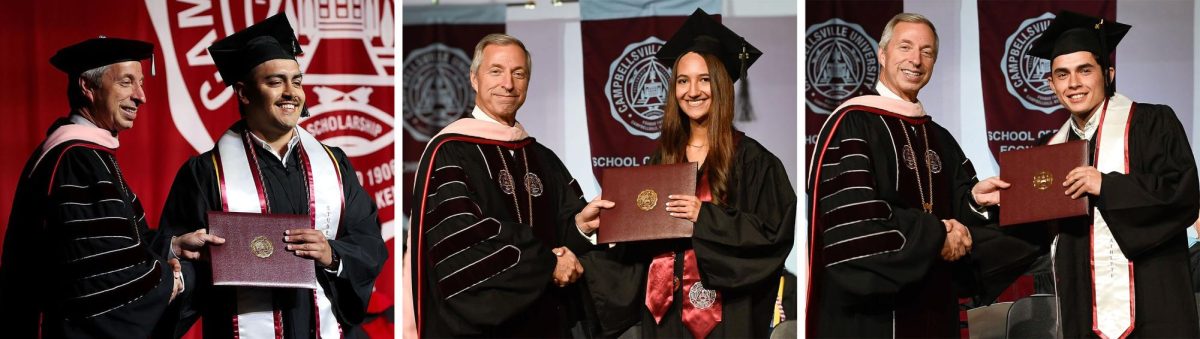
For Soledad Trigo, a 2024 CU mass communication graduate, the OPT process moved quickly.
“I applied in January, and since there were not many graduates at that time, the process was relatively quick,” Trigo said. “It took about one month to be approved.”
She secured a full-time position as a digital marketing specialist on Feb. 24, 2025, before reaching her unemployment deadline in April. Her position is directly related to her major, and she earns $45,000, annually.
“The biggest obstacle was during my interviews when I had to explain that I could not start working until my OPT start date,” Trigo said. “Many employers were looking for candidates who could begin immediately.”
Despite many challenges, she described her employer as supportive and willing to explore sponsorship options. Trigo said she felt academically and professionally prepared for the U.S. job market and praised CGE for clearly explaining OPT requirements.
“In my case, earning my degree increased my professional opportunities,” she said.
Facing employer hesitation
Melvin Monroy also received OPT approval, though his experience reflected additional barriers that many international students go through.
“It took about five weeks to receive approval,” Monroy said.
He secured employment within 90 days, finding a position approximately two to two and a half months after beginning his search. His job is directly related to his major and is part-time.
The salary was below his expectations but reasonable for an entry-level position.
However, Monroy explained that employers’ doubts were the biggest obstacle.
“Employers being hesitant to hire international students was the biggest challenge,” he said. “Many interviews ended or were cut short once I mentioned my visa status.”
While Career Services assisted in reviewing his resume, he primarily connected with employers through job search websites and did not receive direct job placement support from the university.
Despite the difficulties, Monroy said the experience of studying in the United States contributed significantly to his personal and professional growth.
“Beyond the academic knowledge, the experience helped me grow professionally and personally,” he said.
He described Campbellsville University as “a good entry point” for international students seeking future opportunities.
Competition and uncertainty
Lopez’s journey reflects a different point of view of the OPT experience, which for some internationals can be intense competition and long-term planning.
Lopez secured a graduate assistant position in the Sports Information Department, where he works in videography while completing his master’s degree. His role is directly related to his mass communication background.
“It’s very rewarding knowing that athletes like the videos we produce,” he said.
Although his salary is modest, Lopez views the position as an investment in his future.
“It’s not the best thing monetarily, but I’m grateful I can get my master’s paid off and cover my expenses,” he said. “It’s a win-win.”
Lope also pointed to broader immigration uncertainty as a concern. Employer misconceptions about OPT often compounded these concerns. Some companies assume sponsorship is required immediately, even though OPT allows temporary work authorization without employer sponsorship. These misunderstandings can limit opportunities for other qualified candidates.
Past the legal barriers and deadlines, international students frequently face limited professional networks, cultural expectations in every interview and financial pressure. The cost of tuition, OPT filling fees and living expenses adds urgency to the job search process. The 90-day unemployment clock can intensify that stress, sometimes graduates find themselves accepting any position quickly to maintain legal status.
Despite the obstacles, Lopez remains optimistic and plans to pursue OPT after completing his master’s degree.
“I have faith that everything will go as planned,” he said.
For international students at Campbellsville University, OPT represents an opportunity that comes with responsibility. It offers a chance to apply knowledge gained in school in the real-world, and at the same time, gain valuable American work experience. However, strict regulations, employer hesitation, limited networks and immigration uncertainty shape the experience in ways domestic students may not encounter.
The Center for Global Engagement continues to provide structured support. Still, graduates must navigate a competitive labor market and federal immigration policies largely on their own.
For students like Trigo, Monroy and Lopez, OPT is more than just a work permit, it is a decision that can define the future, and can open doors to important opportunities.
What the future holds depends on preparation, persistence and the willingness of employers to look beyond an immigration status, recognizing their potential and invest in those who have already invested in their future in the United States.